

Canon’s EOS DIGITAL REBEL XT (EOS 350D) is a versatile digital SLR, offering high performance and user-friendly operation.
Numerous free manuals and guides are available online, supporting both beginners and experienced photographers.
What is the Canon Rebel XT?
The Canon Rebel XT (EOS 350D), released in 2005, represents a significant step in accessible digital SLR photography. It’s a 8.0-megapixel camera known for its compact size and intuitive controls.
User manuals, readily available online, detail its features, assisting photographers of all levels.
The camera’s popularity stems from its blend of affordability and image quality, making it a great entry point into the world of DSLR photography.
Canon provides comprehensive documentation for this model.
Key Features and Specifications
The Canon Rebel XT (EOS 350D) boasts an 8.0-megapixel APS-C CMOS sensor, delivering detailed images. It features a 9-point autofocus system and continuous shooting up to 3 frames per second.
Manuals highlight its compatibility with EF/EF-S lenses.
The camera records in JPEG and RAW formats, offering flexibility in post-processing.
Key specs include a 1.8-inch LCD screen and support for CompactFlash memory cards. Canon’s documentation details these features extensively.

Getting Started with Your Camera
Canon’s manual guides users through initial setup, including unboxing, battery insertion, and memory card installation. Familiarize yourself with the camera before shooting!
Unboxing and Initial Setup
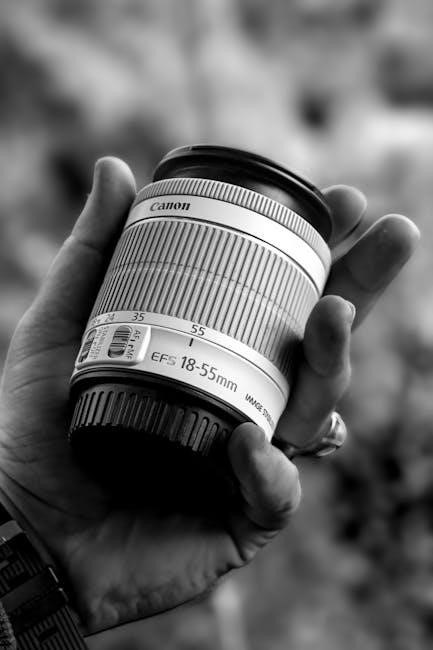
Carefully unpack your Canon EOS DIGITAL REBEL XT, ensuring all components are present – camera body, lens (often the EF-S 18-55mm kit lens), battery, charger, cables, and manuals. Before powering on, inspect for any physical damage. The manual details proper handling.
Initial setup involves attaching the lens, inserting the battery, and a memory card. Consult the user manual for detailed diagrams and instructions. Properly securing the lens is crucial for optimal image quality.
Inserting the Battery and Memory Card
Locate the battery compartment on the bottom of the Canon Rebel XT. Unlock and open the door. Insert the supplied battery pack, ensuring correct polarity as indicated in the manual. Securely latch the compartment closed.
The memory card slot is typically found on the side. Open the cover and insert a compatible card (CompactFlash). Push until it clicks into place. The user manual provides a visual guide. Proper insertion prevents data corruption.
Understanding the Camera Buttons and Dials
The Canon Rebel XT features several key controls. The power switch activates the camera. The mode dial selects shooting modes (Auto, Program, etc.). Shutter button initiates image capture. D-pad navigates menus and selects focus points.
Refer to your manual for detailed explanations of each button’s function. The Set button confirms selections. The Quick Control dial adjusts settings rapidly. Familiarizing yourself with these controls enhances shooting efficiency and creative control.

Basic Camera Settings
Canon Rebel XT settings include date/time, shooting mode selection (Auto, Program, etc.), and ISO adjustments. Consult the manual for detailed guidance on customizing these essential parameters.
Setting the Date and Time
Setting the date and time on your Canon Rebel XT is crucial for accurate image metadata. Access the camera’s menu system – typically through the ‘Menu’ button – and navigate to the ‘Setup’ menu. Within Setup, locate the ‘Date/Time’ setting.
Use the directional buttons to adjust the year, month, day, hour, and minute. Confirm each selection. Accurate timekeeping ensures proper organization and sequencing of your photos, especially when reviewing images later. Refer to your Canon manual for visual guidance.
Choosing the Shooting Mode (Auto, Program, Aperture Priority, Shutter Priority, Manual)
The Canon Rebel XT offers several shooting modes for varying levels of control. ‘Auto’ simplifies photography, letting the camera handle all settings. ‘Program’ (P) allows some adjustments while maintaining automatic exposure. ‘Aperture Priority’ (Av) lets you control depth of field, while ‘Shutter Priority’ (Tv) manages motion blur.
For full creative control, select ‘Manual’ (M). Consult your Canon manual to understand each mode’s nuances and when to utilize them for optimal results. Experiment to master each setting!
Understanding ISO Settings
ISO settings on the Canon Rebel XT control the camera’s sensitivity to light. Lower ISO values (like 100) produce cleaner images in bright conditions. Higher ISO settings (like 800 or 1600) are useful in low light, but introduce more noise or grain.
Refer to your Canon manual for guidance on balancing image quality and low-light performance. Experiment with different ISO levels to find the best compromise for your shooting situation.

Focusing and Shooting
The Canon Rebel XT manual details autofocus modes – One-Shot, AI Servo, and AI Focus – for capturing still or moving subjects effectively. Practice shutter button techniques!
Autofocus Modes (One-Shot, AI Servo, AI Focus)
Canon Rebel XT’s manual explains three autofocus modes. One-Shot is ideal for stationary subjects, locking focus when the shutter button is half-pressed. AI Servo continuously tracks moving subjects, maintaining focus while they move – perfect for sports or wildlife.
AI Focus intelligently switches between One-Shot and AI Servo, detecting subject movement automatically. Understanding these modes, as detailed in the manual, is crucial for sharp, well-focused images, ensuring you capture the moment perfectly, regardless of subject motion.
Focus Points and Selection
The Canon Rebel XT manual details nine autofocus points, offering flexibility in composition and focus control. Users can select a single focus point for precise targeting, or allow the camera to automatically choose one. Manual selection, guided by the manual, is beneficial for specific compositions.
Understanding how to navigate and choose focus points is key to achieving sharp images. The manual explains how to use the directional buttons to move the active focus point, ensuring critical elements are in focus, enhancing overall image quality and creative control.
Taking a Picture: Shutter Button Techniques
The Canon Rebel XT manual emphasizes a two-step shutter button press for optimal focus and exposure. Gently pressing halfway activates autofocus, locking focus on your subject. Holding it allows for exposure metering.
Fully depressing the shutter button then captures the image. The manual advises a smooth, steady press to minimize camera shake. Learning this technique, as detailed in the manual, is crucial for sharp, well-exposed photographs, improving overall shooting accuracy and image quality.

Understanding Exposure
The Canon Rebel XT manual details how aperture, shutter speed, and ISO interact to control exposure. Mastering these settings, as explained in the manual, is key to creative control.
Aperture and Depth of Field
The Canon Rebel XT manual thoroughly explains aperture’s role in controlling light and depth of field. A wider aperture (lower f-number) creates a shallow depth of field, ideal for isolating subjects with a blurred background. Conversely, a narrower aperture (higher f-number) increases depth of field, keeping more of the scene in focus.
Understanding this relationship, detailed within the manual, allows photographers to creatively control the focus and aesthetic of their images. Experimentation with different f-stops is encouraged to achieve desired results.
Shutter Speed and Motion Blur
The Canon Rebel XT manual details how shutter speed impacts motion depiction. Faster shutter speeds freeze action, preventing blur, while slower speeds intentionally introduce motion blur, conveying a sense of movement. The manual explains that choosing the correct shutter speed depends on the subject and desired effect.
Experimenting with various speeds, as guided by the manual, is crucial for capturing sharp images or artistically representing motion. Understanding this control is fundamental to photographic expression.
Exposure Compensation
The Canon Rebel XT manual explains exposure compensation as a tool to fine-tune brightness. When the camera’s meter is fooled by bright or dark scenes, this feature allows you to override the automatic setting. The manual details using the +/- button to brighten or darken images.
Positive values increase brightness, while negative values decrease it. Mastering exposure compensation, as the manual instructs, ensures properly exposed photos in challenging lighting conditions, preventing over or underexposure.
Working with Menus
The Canon Rebel XT manual details navigating the camera’s menu system for customizing settings. Users can adjust image quality, white balance, and other features through these options.
Navigating the Menu System
Canon Rebel XT’s menu system, as explained in the manual, is accessed via the ‘MENU’ button. It’s divided into several tabs – shooting, AF, setup, and more – each containing related settings.
Use the cross keys to highlight options and the ‘SET’ button to select.
The manual emphasizes understanding each menu’s function for optimal camera control.
Carefully reviewing the Canon provided user guide will help you quickly locate and adjust settings to your preferences, enhancing your photographic experience.
Customizing Camera Settings
The Canon Rebel XT manual details extensive customization options. Within the menu, you can personalize settings like image quality, beep sounds, and display format.
Adjusting the ‘Custom Functions’ allows tailoring button operations to your shooting style.
The user guide highlights setting up custom white balance and picture styles for unique image looks.
Experimenting with these settings, as the Canon manual suggests, unlocks the camera’s full potential and streamlines your workflow.
Understanding Menu Options for Image Quality
The Canon Rebel XT manual explains crucial image quality settings. Choose between JPEG and RAW formats; RAW offers greater editing flexibility.
Resolution options range from low to high, impacting file size and detail.
The user guide details white balance presets and custom settings for accurate color.
Picture Style controls (Standard, Portrait, Landscape) modify image characteristics. Referencing the Canon documentation ensures optimal image quality tailored to your needs.
Image Playback and Review
The Canon Rebel XT manual details reviewing photos on the LCD screen, deleting unwanted images, and utilizing zoom/rotate functions for detailed inspection.
Viewing Images on the LCD Screen
Canon Rebel XT’s manual explains that images are readily viewed on the camera’s LCD screen after capture. Pressing the playback button initiates image review.
Users can navigate through stored photos using the directional buttons. The zoom button allows for closer inspection of details, confirming focus and sharpness.
Histogram display, as detailed in the manual, aids in assessing exposure accuracy.
Rotation features are also available for proper viewing orientation.
Deleting Images
The Canon Rebel XT manual details a straightforward image deletion process. Within playback mode, select the image and press the delete button – often indicated by a trash can icon.
A confirmation screen appears to prevent accidental erasure. Users can delete single images or utilize bulk deletion options for efficiency.
Be cautious, as deleted images are typically unrecoverable, as the manual warns. Protect important photos by utilizing card lock features.
Zooming and Rotating Images
The Canon Rebel XT manual explains image zooming for detailed review. During playback, utilize the zoom control (often the cross keys) to magnify images, checking focus and detail.
Rotation functionality allows correcting image orientation directly on the camera. The manual clarifies that rotated images are saved with the new orientation metadata.
This feature is useful for photos taken in portrait mode, ensuring correct display on various devices.

File Formats and Image Quality
The Canon Rebel XT manual details JPEG and RAW options. RAW files offer greater editing flexibility, while JPEGs are readily compatible.
Adjust resolution and white balance settings for optimal image quality.
JPEG vs. RAW Image Formats
Canon Rebel XT’s manual explains that JPEG files are compressed, ready to share, and smaller in size, but lose some data. RAW files, conversely, retain all image data captured by the sensor.
This allows for extensive non-destructive editing – adjustments won’t degrade the original image. However, RAW files are significantly larger and require processing in software like Canon’s Digital Photo Professional. Choosing depends on your workflow and editing needs; JPEGs for convenience, RAW for maximum control.
Image Resolution Settings
The Canon Rebel XT manual details several resolution options, impacting image size and detail. Higher resolutions (like Large, approximately 6.3 megapixels) yield larger files suitable for printing and cropping. Lower resolutions (Medium, Small) create smaller files ideal for web use or email.
Understanding these settings is crucial for balancing image quality with storage space. The manual advises selecting the appropriate resolution based on intended use, optimizing both quality and efficiency.
White Balance Settings
The Canon Rebel XT manual explains white balance adjusts colors to appear natural under different lighting conditions. Auto White Balance (AWB) is convenient, but presets like Daylight, Cloudy, Tungsten, and Fluorescent offer greater control.
Custom White Balance allows precise adjustment using a white or gray card. Incorrect white balance results in color casts; the manual emphasizes selecting the correct setting for accurate, lifelike images. Experimentation is encouraged to master this crucial feature.

Using Flash
The Canon Rebel XT manual details built-in flash modes for various scenarios. It also covers compatibility with external flashes, and flash exposure compensation techniques.
Built-in Flash Modes
The Canon Rebel XT manual comprehensively explains the camera’s integrated flash functionality. Several modes are available, including Auto, Red-Eye Reduction Auto, Flash On, and Flash Off; Auto mode lets the camera decide when flash is needed, while Red-Eye Reduction minimizes red-eye effects in portraits.
Selecting Flash On forces the flash to fire with every shot, useful in low-light conditions. Conversely, Flash Off disables the built-in flash, allowing for natural lighting or external flash use. Understanding these modes, as detailed in the manual, is crucial for optimal image results.
External Flash Compatibility
The Canon Rebel XT manual details its compatibility with a range of Canon Speedlite external flashes. Utilizing an external flash offers greater power, control, and creative lighting options compared to the built-in flash. The camera supports E-TTL (Evaluating Through-The-Lens) flash metering for accurate exposures.
The manual explains how to connect and configure compatible Speedlites, including settings for high-speed sync and flash exposure compensation. It also outlines compatibility with older, non-TTL flashes, though functionality may be limited.
Flash Exposure Compensation
The Canon Rebel XT manual explains Flash Exposure Compensation (FEC) as a crucial tool for fine-tuning flash output. FEC allows photographers to brighten or darken flash-lit images without altering other camera settings. The manual details how to adjust FEC in plus or minus EV steps, influencing the flash’s intensity.
Understanding FEC is vital for achieving properly exposed photos in challenging lighting conditions. The manual provides guidance on using FEC creatively to control shadows and highlights, ensuring balanced and visually appealing results.

Troubleshooting Common Issues
The Canon Rebel XT manual addresses issues like the camera not powering on, error messages, and lens compatibility. Solutions and explanations are provided for common user problems.
Camera Not Turning On
The Canon Rebel XT manual details several reasons why your camera might fail to power on. First, ensure the battery is fully charged and correctly inserted, checking the polarity.
Verify the battery contacts are clean and free of corrosion. A depleted or faulty battery is a frequent cause.
Also, confirm the mode dial isn’t set to ‘OFF’. If problems persist, try a different, known-good battery to isolate the issue. Consult the manual’s troubleshooting section for further guidance.
Error Messages and Solutions
The Canon Rebel XT manual lists various error messages and their corresponding solutions. “Err 99” often indicates a shutter curtain issue, requiring professional repair. Other errors might relate to the memory card – try reformatting or using a different card.
The manual advises checking lens compatibility and ensuring proper attachment. Resetting the camera to factory defaults can resolve software glitches. Detailed explanations and troubleshooting steps are provided within the manual itself.
Lens Compatibility Problems
The Canon Rebel XT manual details compatible lenses, primarily Canon EF and EF-S lenses. Using non-compatible lenses can cause errors or damage. Ensure the lens is securely mounted and the contacts are clean. The manual highlights potential issues with third-party lenses, advising caution.
If a lens isn’t recognized, check for firmware updates. The manual stresses using Canon-approved accessories for optimal performance and avoiding adapters where possible.
Downloading the Canon Rebel XT Manual
Canon’s official website provides a downloadable Rebel XT manual. Numerous third-party sites also host guides, offering convenient access to user instructions and support resources.
Official Canon Website Resources
Canon’s official website remains the primary source for the Rebel XT (EOS 350D) manual. While direct links can evolve, navigating the support section for discontinued products usually yields results.
Users can often find comprehensive documentation, including the complete owner’s manual in PDF format, alongside frequently asked questions and troubleshooting guides.
Exploring the Canon support pages allows access to firmware updates and additional resources designed to enhance the camera’s functionality and address common user concerns.
Third-Party Manuals and Guides
Beyond Canon’s official resources, numerous third-party websites offer Rebel XT (EOS 350D) manuals and tutorials. These can be valuable supplements, often presenting information in alternative formats or with different instructional approaches.
Online forums and photography communities frequently host user-created guides and troubleshooting tips. Websites dedicated to archiving older camera manuals also provide accessible PDFs. However, verifying the accuracy of information from unofficial sources is crucial for optimal camera operation.

Resources and Further Learning
Explore online forums and the official Canon support website for extensive resources. These platforms offer valuable insights, troubleshooting, and community support for your Rebel XT.
Online Forums and Communities
Numerous online forums are dedicated to Canon cameras, including the Rebel XT (EOS 350D). These communities provide a space to ask questions, share experiences, and learn from other photographers.
Users frequently post solutions to common issues, offer advice on settings, and discuss techniques. Websites like photography-related subreddits and dedicated Canon forums can be invaluable resources for troubleshooting and expanding your knowledge. Engaging with these communities fosters learning and provides practical support.
Canon Support Website
Canon’s official support website is a primary resource for Rebel XT (EOS 350D) owners. It offers downloadable manuals, software updates, and frequently asked questions (FAQs).
Users can find detailed information regarding camera operation, troubleshooting steps, and driver installations. While the Rebel XT is an older model, Canon often retains support materials for previous cameras. Accessing this website provides direct assistance and ensures compatibility with your operating system.