Volleyball Weight Training Program: A Comprehensive Guide
Elevate your game! This comprehensive program builds stamina, agility, and strength, offering effective exercises for both gym and home training, focusing on vertical leap development.
Volleyball demands a unique blend of athleticism – explosive power, agility, and endurance; A well-structured weight training program is crucial for maximizing performance and minimizing injury risk. This guide provides a comprehensive approach, moving beyond simply building muscle to specifically targeting the physical requirements of the sport.
Unlike programs focused solely on hypertrophy, this plan prioritizes functional strength, power development, and core stability. We’ll explore how to translate gym gains into improved vertical jump, faster court movement, and more powerful spikes and blocks. Whether you’re a seasoned athlete or just beginning, this program offers scalable exercises and periodization strategies to help you reach your full potential.
This isn’t just about lifting weights; it’s about building a resilient and explosive athlete, prepared to dominate on the court.
II. Understanding the Physical Demands of Volleyball
Volleyball is a highly dynamic sport requiring repeated bursts of explosive movement. Players constantly jump, sprint, change direction, and deliver powerful overhead strikes. These actions place significant stress on the musculoskeletal system, demanding a high level of strength, power, and agility.
Specifically, strong legs are vital for jumping ability, while a powerful core provides stability and transfers force efficiently. Upper body strength is crucial for hitting and blocking, and shoulder stability prevents injuries. Furthermore, the repetitive nature of the sport necessitates excellent endurance and the ability to recover quickly between rallies.
A successful training program must address all these demands, focusing on developing both strength and power, alongside injury prevention strategies. Ignoring any component can limit performance and increase the risk of setbacks.
III. Key Components of a Volleyball Weight Training Program
A well-rounded volleyball weight training program integrates three crucial components: strength training, plyometrics, and core stability work. Strength training builds a foundation of muscular strength, essential for generating power and handling the physical load of the sport. Plyometrics enhance explosiveness and reactive strength, directly improving jump height and quickness.
Core stability exercises are paramount, providing a solid base for all movements and protecting against injuries. A strong core improves balance, coordination, and force transfer throughout the body. These components aren’t isolated; they synergistically contribute to overall athletic performance.
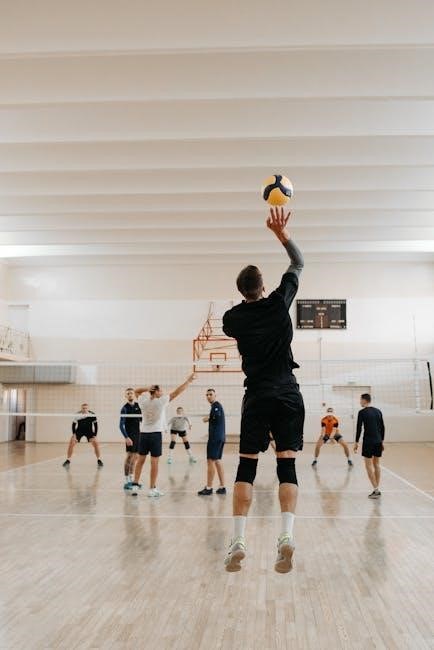
Prioritizing all three ensures a comprehensive approach, maximizing gains in power, agility, and injury resilience, ultimately leading to improved performance on the court.
A. Strength Training for Power and Jump Height
Strength training is foundational for volleyball athletes, directly impacting power output and vertical jump height. Focus should be placed on compound movements that engage multiple muscle groups simultaneously. These exercises, like squats, deadlifts, and lunges, build overall strength and translate effectively to on-court actions.
Increasing lower body strength is critical, but don’t neglect upper body work. A strong upper body contributes to powerful hitting and blocking. Progressive overload – gradually increasing weight or resistance – is key to continued gains. Proper form is paramount to prevent injuries and maximize effectiveness.
Consistent strength training builds the muscular base needed for explosive movements, ultimately enhancing athletic performance.
B. Plyometrics for Explosiveness and Reactivity
Plyometric exercises are essential for developing the explosive power and quick reactivity demanded by volleyball. These movements focus on the stretch-shortening cycle – rapidly stretching a muscle followed by an immediate contraction. This enhances the ability to jump higher, move faster, and change direction quickly.
Examples include box jumps, depth jumps, and jump squats. Proper technique is crucial; start with lower impact variations and gradually increase intensity. Plyometrics should be incorporated after a solid strength training base is established to minimize injury risk.
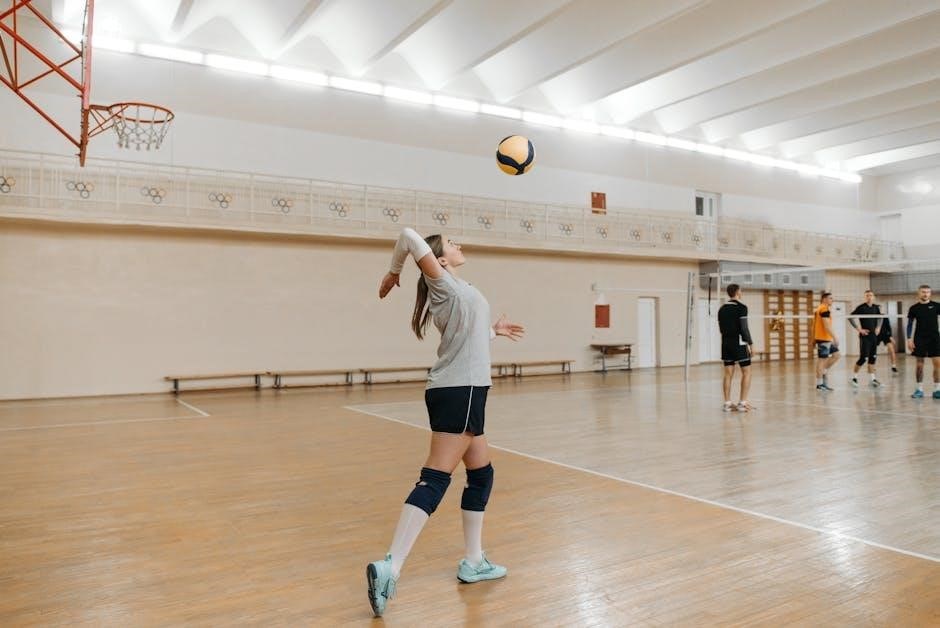
Focus on minimizing ground contact time and maximizing effort during each repetition. Integrating plyometrics into your routine will significantly improve your on-court explosiveness and agility.
C. Core Stability for Balance and Injury Prevention
A strong core is foundational for volleyball performance, providing stability and transferring power efficiently between the upper and lower body. Core stability isn’t just about “six-pack abs”; it encompasses the muscles of the abdomen, back, and pelvis working together.
Exercises like planks, Russian twists, and medicine ball rotations are vital. A stable core improves balance during jumps, landings, and quick directional changes, reducing the risk of ankle, knee, and lower back injuries.
Prioritize exercises that challenge core stability in multiple planes of motion. Consistent core work will enhance your overall athleticism and contribute to a more resilient and powerful game.
IV. Warm-up and Cool-down Routines
Proper preparation and recovery are crucial components of any effective volleyball weight training program. A dynamic warm-up prepares your muscles for exertion, increasing blood flow and range of motion. Include movements like arm circles, leg swings, torso twists, and light cardio – mimicking volleyball actions.
Conversely, a cool-down aids recovery, reducing muscle soreness and improving flexibility. Static stretching, holding each stretch for 20-30 seconds, is ideal post-workout. Focus on major muscle groups used during training, like quads, hamstrings, calves, and shoulders.
Neglecting these routines increases injury risk and hinders performance gains. Prioritize both warm-up and cool-down for optimal results.
A. Dynamic Stretching for Pre-Workout Preparation
Prepare for peak performance with a dynamic stretching routine before each volleyball weight training session. Unlike static stretches, dynamic movements actively warm up muscles and joints through a full range of motion, enhancing flexibility and reducing injury risk.
Effective exercises include arm circles (forward & backward), leg swings (forward, backward, & sideways), torso twists, high knees, butt kicks, and walking lunges with a twist. Mimic volleyball-specific movements like shoulder rotations and quick footwork drills.
Focus on controlled movements, gradually increasing the range of motion. A proper dynamic warm-up increases blood flow, improves muscle elasticity, and primes the nervous system for intense activity.
B. Static Stretching for Post-Workout Recovery
Optimize recovery and flexibility with static stretching following your volleyball weight training. Holding each stretch for 20-30 seconds allows muscles to lengthen and repair, reducing soreness and improving long-term flexibility.
Key stretches include hamstring stretches (seated or standing), quadriceps stretches, calf stretches, shoulder stretches (across the body and overhead), and triceps stretches. Focus on feeling a gentle pull, not pain.
Static stretching helps restore muscles to their optimal length, improving joint range of motion and preventing imbalances. Incorporate these stretches into your cool-down routine to enhance recovery and prepare your body for the next training session.
V. Sample Weight Training Exercises
Build a foundation of strength with these exercises, crucial for volleyball performance. Lower body work focuses on explosive power – essential for jumping and agility. Include Back Squats, Front Squats, and Goblet Squats to build overall leg strength.
Lunges (Forward, Reverse, and Walking) enhance unilateral strength and balance. Don’t forget Deadlifts (Conventional and Romanian) for posterior chain development. Finish with Standing and Seated Calf Raises for powerful ankle stability.
Upper body exercises like Bench Press (Barbell and Dumbbell) and Overhead Press (Barbell and Dumbbell) build pushing strength. Pull-ups/Lat Pulldowns and Rows (Barbell and Dumbbell) develop pulling strength, creating balanced muscle development.
A. Lower Body Exercises
Maximize your vertical leap and agility with a focused lower body regimen. Squats – Back, Front, and Goblet – are foundational, building comprehensive leg strength and power. Prioritize proper form to prevent injury and maximize effectiveness. Aim for 3-4 sets of 8-12 repetitions.
Lunges (Forward, Reverse, and Walking) enhance unilateral strength, crucial for dynamic movements on the court. Incorporate these for improved balance and coordination. Deadlifts (Conventional and Romanian) target the posterior chain, vital for explosive power.
Finally, Calf Raises (Standing and Seated) strengthen ankles, improving jump height and reducing injury risk. Consistent lower body training is paramount for volleyball success.
Squats (Back Squats, Front Squats, Goblet Squats)
Squats are the cornerstone of any effective volleyball weight training program, building foundational lower body strength. Back Squats, utilizing a barbell across the upper back, maximize overall weight lifted and develop comprehensive leg power. Front Squats, with the barbell held in front, emphasize quadriceps and core engagement, improving posture.
Goblet Squats, using a dumbbell or kettlebell held close to the chest, are excellent for beginners, teaching proper squat mechanics and building foundational strength. Focus on maintaining a straight back, controlled descent, and explosive ascent.
Progressive overload – gradually increasing weight – is key for continued gains. Incorporate variations to target different muscle groups and prevent plateaus.
Lunges (Forward, Reverse, Walking)
Lunges are crucial for developing unilateral leg strength – strength in each leg independently – vital for volleyball’s dynamic movements. Forward Lunges mimic the split-step and landing mechanics, enhancing stability and power. Reverse Lunges are gentler on the knees, focusing on glute and hamstring activation, improving deceleration control.
Walking Lunges build endurance and coordination, simulating court movement. Maintain a 90-degree angle in both knees during each lunge, keeping your core engaged and back straight. Adding dumbbells or a barbell increases the challenge.
Focus on controlled movements and full range of motion. Prioritize proper form to prevent injuries and maximize effectiveness.
Deadlifts (Conventional, Romanian)
Deadlifts are foundational for overall strength and power development, translating directly to improved jump height and explosive movements on the court. Conventional Deadlifts engage the entire posterior chain – back, glutes, and hamstrings – building substantial strength. Romanian Deadlifts (RDLs) emphasize hamstring and glute flexibility and strength, crucial for preventing hamstring strains.
Maintain a straight back throughout the lift, hinging at the hips and keeping the core braced. Proper form is paramount to avoid injury. Start with lighter weights and gradually increase the load as strength improves.
Deadlifts enhance athletic power and resilience, making them a cornerstone of a volleyball-specific weight training program.
Calf Raises (Standing, Seated)
Strong calves are essential for volleyball players, contributing to explosive jumping ability and quick footwork. Standing Calf Raises target the gastrocnemius muscle, the larger, more visible calf muscle, while Seated Calf Raises focus on the soleus, located underneath. Developing both muscles provides comprehensive calf strength.
Perform calf raises with a full range of motion, ensuring a deep stretch at the bottom and a strong contraction at the top. Controlled movements are key; avoid bouncing. Utilize a weight that challenges you while maintaining proper form.
Consistent calf training improves vertical jump and agility, vital components for success on the volleyball court.
B. Upper Body Exercises
A robust upper body is crucial for powerful spiking, blocking, and serving in volleyball. These exercises build the necessary strength and stability. Bench Press (Barbell or Dumbbell) develops pushing power, essential for explosive movements. Overhead Press (Barbell or Dumbbell) enhances shoulder strength and stability, vital for overhead actions.
Pull-ups or Lat Pulldowns strengthen the back and biceps, improving pulling strength for blocking and controlling the ball. Rows (Barbell or Dumbbell) further develop back muscles, contributing to overall upper body power and posture.
Focus on controlled movements and proper form to maximize effectiveness and prevent injuries. Incorporate these exercises to elevate your game!
Bench Press (Barbell, Dumbbell)
The Bench Press is a foundational exercise for developing upper body pushing strength, directly translating to a more powerful spike and block in volleyball. Utilizing a barbell allows for heavier loads, promoting significant strength gains. Dumbbell variations enhance stability and address muscle imbalances.
Proper form is paramount: maintain a slight arch in your back, feet flat on the floor, and controlled descent of the weight to your chest. Focus on explosive upward movement, locking out your elbows at the top.
Begin with a weight you can comfortably lift for 8-12 repetitions, gradually increasing the load as you get stronger. Incorporate 3-4 sets for optimal results. Prioritize safety and consider a spotter when lifting heavier weights.
Overhead Press (Barbell, Dumbbell)
The Overhead Press is crucial for volleyball players, building shoulder and upper back strength essential for powerful serving and blocking. Barbell presses allow for maximal weight, fostering overall strength development. Dumbbell variations improve stability and range of motion, addressing potential imbalances.
Maintain a stable core and upright posture throughout the exercise. Initiate the movement by pressing the weight directly overhead, fully extending your arms without hyperextending your elbows. Control the descent, lowering the weight slowly and deliberately.
Aim for 3-4 sets of 6-10 repetitions, progressively increasing the weight as you gain strength. Proper form is vital to prevent injury; consider starting with lighter weights to master the technique.
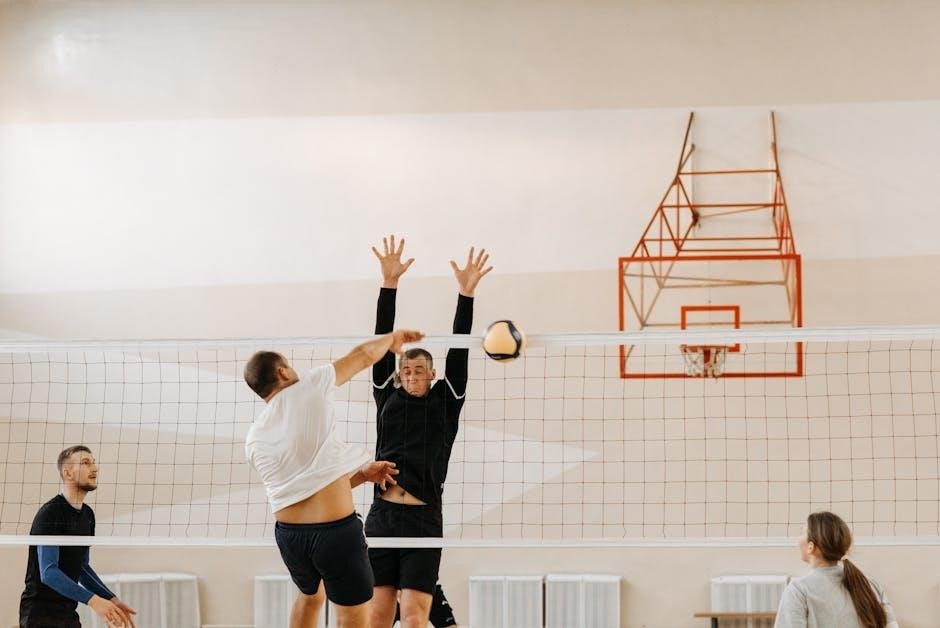
Pull-ups/Lat Pulldowns
Developing a strong back is paramount for volleyball athletes, directly impacting hitting power and shoulder stability. Pull-ups, a challenging bodyweight exercise, build significant upper body strength. If pull-ups are initially too difficult, lat pulldowns provide an excellent alternative, allowing for adjustable resistance.
For pull-ups, grip the bar slightly wider than shoulder-width apart, and pull yourself up until your chin clears the bar. Control the descent. Lat pulldowns mimic this movement using a cable machine. Focus on squeezing your shoulder blades together during the pull.
Perform 3-4 sets of as many repetitions as possible (AMRAP) for pull-ups, or 8-12 repetitions for lat pulldowns. Prioritize controlled movements over sheer quantity.
Rows (Barbell, Dumbbell)
Strengthening the back muscles is crucial for volleyball players, contributing to powerful swings and improved posture. Rows, whether performed with a barbell or dumbbells, target these essential muscle groups. Barbell rows allow for heavier loads, promoting overall strength gains, while dumbbell rows offer a greater range of motion and address muscle imbalances.
Maintain a flat back and engage your core throughout the exercise. Pull the weight towards your lower chest, squeezing your shoulder blades together. Control the eccentric (lowering) phase.
Aim for 3-4 sets of 8-12 repetitions for both barbell and dumbbell rows. Varying your grip (overhand, underhand) can target different back muscles.
VI. Program Periodization for Volleyball
Strategic training adjustments throughout the year are vital for peak performance and injury prevention. Periodization divides training into phases, each with specific goals. The Off-Season Strength Building Phase focuses on foundational strength with heavier weights and lower repetitions, building a solid base.
Transitioning into the Pre-Season Power and Speed Phase, the emphasis shifts to explosive movements and power development, utilizing lighter weights and higher velocities. Finally, the In-Season Maintenance Phase prioritizes maintaining strength and power while managing fatigue, employing lower volume and intensity.
Proper periodization prevents plateaus, optimizes gains, and ensures athletes are at their best during crucial competitions.
A. Off-Season Strength Building Phase
Foundation first! This phase, typically spanning several months, prioritizes building a robust strength base. Focus on compound lifts – squats, deadlifts, bench press, and overhead press – utilizing heavier weights (80-85% of 1RM) and lower repetition ranges (3-5 sets of 5-8 reps).
The goal isn’t immediate power, but establishing the raw strength needed for subsequent phases. Incorporate accessory exercises to address muscle imbalances and strengthen supporting muscles. Proper form is paramount to prevent injuries during this demanding period.
Nutrition should support muscle recovery and growth, with adequate protein intake. This phase sets the stage for explosive power development later on.
B. Pre-Season Power and Speed Phase
Translate strength to explosiveness! This phase, occurring 6-8 weeks before the season, shifts the focus from maximal strength to power development. Reduce the weight (60-70% of 1RM) and increase the velocity of movements. Incorporate plyometrics – jump squats, box jumps, and depth jumps – to enhance reactive strength and jump height.
Repetition ranges become higher (3-5 sets of 8-12 reps) with an emphasis on explosive execution. Olympic lifts, like cleans and snatches (if properly coached), can be highly beneficial. Continue core work and maintain strength levels with reduced volume.
This phase prepares the athlete for the specific demands of volleyball, maximizing power output and agility.
C. In-Season Maintenance Phase
Preserve gains and prevent fatigue! During the competitive season, the goal is to maintain strength and power developed in previous phases, not to build further. Reduce training volume significantly (2-3 sessions per week) and prioritize recovery. Focus on compound movements with moderate weight (60-70% of 1RM) for 2-3 sets of 6-8 repetitions.
Prioritize exercises that address specific weaknesses or imbalances. Continue core stability work and incorporate light plyometrics for reactivity. Avoid heavy lifting close to competitions to minimize soreness and fatigue.
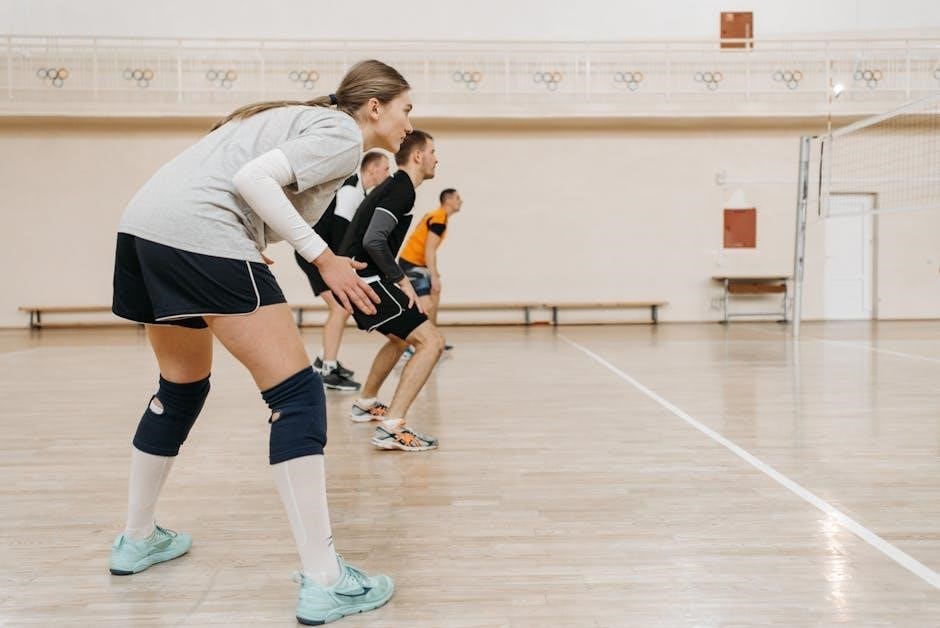
Listen to your body and adjust the program based on match schedules and individual recovery needs. This phase ensures peak performance throughout the season.
VII. Injury Prevention Strategies
Proactive protection is key! Volleyball demands explosive movements, making injury prevention crucial. A well-structured warm-up, including dynamic stretching, prepares muscles for activity. Incorporate exercises strengthening rotator cuff muscles, crucial for shoulder stability, and focus on ankle and knee stability through targeted exercises.
Proper landing mechanics are vital; practice absorbing impact correctly. Core strengthening enhances overall stability and reduces strain on joints. Prioritize flexibility through regular static stretching post-workout;
Gradual progression in training intensity minimizes overuse injuries. Listen to your body, address pain promptly, and don’t push through discomfort. Consistent attention to these strategies will keep you on the court!
VIII. Nutrition for Volleyball Athletes
Fueling performance is paramount! Volleyball athletes require a diet supporting high energy demands and rapid recovery. Prioritize complex carbohydrates – whole grains, fruits, and vegetables – for sustained energy. Lean protein sources, like chicken, fish, and beans, are essential for muscle repair and growth.
Hydration is non-negotiable; drink water consistently throughout the day, especially before, during, and after training. Healthy fats, found in avocados and nuts, support hormone production and overall health.
Timing your nutrient intake is crucial; consume a carbohydrate-rich meal 2-3 hours before training and a protein-rich snack within 30-60 minutes post-workout. A balanced diet optimizes performance and minimizes injury risk.
IX. Monitoring Progress and Adjusting the Program
Consistent evaluation is key! Regularly track your progress – lift heavier weights, jump higher, and improve sprint times. Keep a training log detailing exercises, sets, reps, and weight used. Monitor your body composition, noting changes in muscle mass and body fat percentage.
Pay attention to how your body feels. Fatigue, soreness, or pain are signals to adjust the program. Don’t hesitate to reduce volume or intensity if needed. Periodically reassess your goals and modify the program accordingly.
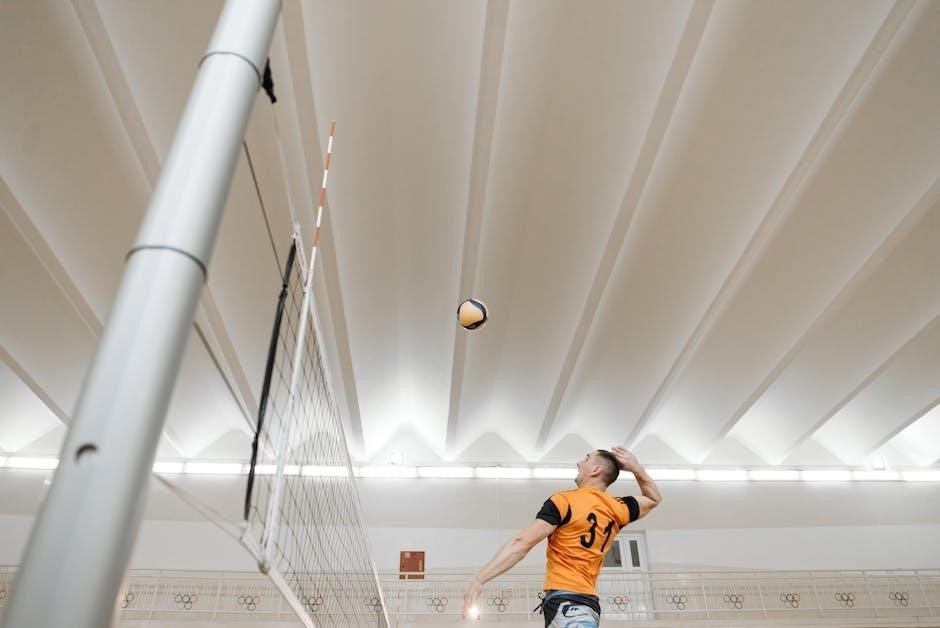
Progress isn’t always linear; plateaus are normal. Introduce variations in exercises or training methods to overcome them. Seeking guidance from a coach or trainer can provide valuable insights and ensure continued improvement.